










| |
|
|
|
|
||
Welcome & farewell to John
Welcome to LamboWeb's home page. This site was originally created by fellow Lamborghini enthusitest and owner John Monahan. For years his site has serves 100's of do-it-yourselfers and Lamborghini owners alike. I reffered many friends and customers to John's site over the years until I learn last year a domain vulture (someone who grabs domain names as soon as they are not re-registered and then extores money to buy them back) I, along with many other fans of the site were devistated not to have this resource around. With John wanting to "retire" from maintining the site and the vulture sealing the domain, I worked diligently to purchase the name back, get a copy of the entire website from John to host the site on our servers. I hope to be able to continue the tradition of his site and welcome anyone with time to assit or make suggestions as I look to refresh the site and update it.
Thank you
Jason Jones
Bullstuff.com/Lambostuff.com
This web site is setup for people who own or are interested in Lamborghini cars. Particular focus will be given to recent cars, the Countach, Diablo, Murciélago and Gallardo models. No attempt is made to be a complete site for all things Lamborghini, rather the web site will focus on Lamborghini news events, input via forums and repair suggestions from users like you. Please pass the word on to friends.
Lamborghini Cars
The Miura
Lamborghini made many cars in small numbers over the years. Only a few of these would be recognized by the general public. In the early years these included such as the 350 GT and GTS, and the 400 GT 2+2. These were all cars of the early to mid 60's. The car that more or less put Lamborghini on the map was the P400 Miura. It was first shown on November 1965 at the Turin Auto Show by Ferruccio Lamborghini who astonished everybody with this car, only the chassis was shown at the show, the engine was transversely mid-mounted, something up to then only seen in real F1 race cars. The design of the body was executed by Marcello Gandini in less than a year, and on the March 1966 Geneva Show it was completed and on display. It looked even better than in Turin. The car was very aggressively styled, and an appropriate name was chosen for it, the Miura, a name taken from the ferocious Spanish fighting bulls.
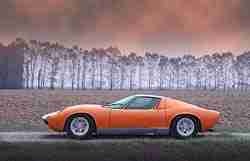 For
the styling of the Miura, Gandini was inspired by the US Ford GT-40. As
in the case of the GT-40 the complete front and rear body parts were
hinged to tilt upwards. The car was also very low, the roof was only
1055 mm above the road, with as little as 130 mm ground clearance.
While the styling looked very sexy, the car suffered from a severe front
lift when reaching its top speed of ~280 km/h. Heating was also a
problem. With that large V-12 engine just behind your back it
could get very hot in a Miura, and it was always very noisy.
Nevertheless the car was a real success from the very start. About 470
units were built before it was replaced by an even wilder
Miura S. The Miura S
was introduced in 1969. In the 'S' (for Spint), the rear
suspension of the P400 was modified and the tires were upgraded to
Pirelli Cinturato series 70's. However the most important change over
the P400 model was that heavier-gauge steel used for the chassis. This
cut down on some of the flexing seen on the earlier cars.
For
the styling of the Miura, Gandini was inspired by the US Ford GT-40. As
in the case of the GT-40 the complete front and rear body parts were
hinged to tilt upwards. The car was also very low, the roof was only
1055 mm above the road, with as little as 130 mm ground clearance.
While the styling looked very sexy, the car suffered from a severe front
lift when reaching its top speed of ~280 km/h. Heating was also a
problem. With that large V-12 engine just behind your back it
could get very hot in a Miura, and it was always very noisy.
Nevertheless the car was a real success from the very start. About 470
units were built before it was replaced by an even wilder
Miura S. The Miura S
was introduced in 1969. In the 'S' (for Spint), the rear
suspension of the P400 was modified and the tires were upgraded to
Pirelli Cinturato series 70's. However the most important change over
the P400 model was that heavier-gauge steel used for the chassis. This
cut down on some of the flexing seen on the earlier cars.
During the S model production, ventilated disc brakes were introduced, later power windows also became standard. A passenger grab handle was installed near the gear stick shift. The engine was slightly altered, the combustion chambers were reshaped, higher-lift cams and larger carburetors on fatter manifolds boosted power to a about 370 bhp.
The Countach
At the 1973 Geneva Auto Show, Lamborghini shocked the world again with its revolutionary LP400 Countach. Only a prototype was shown. Today it is difficult to realize the impact that car had on everybody at that time. Even now the car is a show stopper! The car at the show was painted in a bright red and with a black suede interior. It showed for the first time the by now, Lamborghini signature swing up doors. It also displayed unique vertically mounted rear air intakes to go with its powerful 3.93 Liter engine.
It took the Lamborghini
development team over two years to convert the prototype into a salable
car and get it right. Cooling problems were
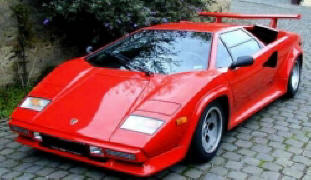 a real challenge especially
at high speed. This was a difficult time for Lamborghini. Its
tractor division a severe financial loss that essentially bankrupted the
company. In fact at the very time the first LP400 Countach was shown on
the 1974 Geneva Auto Show, Ferruccio Lamborghini sold his company to a
Swiss group of investors. The future of Automobili Ferruccio Lamborghini
was not
clear.
There were a number of uncertain years. In fact it was the Countach,
this single spectacular model that kept the company alive. The first
production Countach left the factory early in 1974. Approximately
150 LP400's were manufactured.
a real challenge especially
at high speed. This was a difficult time for Lamborghini. Its
tractor division a severe financial loss that essentially bankrupted the
company. In fact at the very time the first LP400 Countach was shown on
the 1974 Geneva Auto Show, Ferruccio Lamborghini sold his company to a
Swiss group of investors. The future of Automobili Ferruccio Lamborghini
was not
clear.
There were a number of uncertain years. In fact it was the Countach,
this single spectacular model that kept the company alive. The first
production Countach left the factory early in 1974. Approximately
150 LP400's were manufactured.
In 1978 the Countach LP400S came out. The car was an improvement on some of the issues that appeared in the LP400. The car came with improved tires (Pirelli P7's) and with the now famous telephone-dial wheels. The car was made a little taller to take care of the numerous complaints people had about lack of headroom. The engine was enlarged to 4.754L which put our 375 HP. Other less noticeable changes like an improved suspension were also added. Approximately 230 LP400S's were manufactured.
In 1982 the Countach 500S came out. It had a 4.75L engine and was fitted with a new electronic ignition system. Total horsepower however did not really improve that much remaining at about 375 HP. Approximately 320 LP500S's were manufactured.
In 1985 the Countach LP500 QV was delivered. This was really the original plan for the car. Finally the engineers caught up with what the designers had planed for the car all along. QV stands for "Quatro Valve" or 4 valves per cylinder. The engine was further enlarged (5.17L) and deliver between 450 - 460 HP depending on tuning. Approximately 600 LP500 QV's were manufactured
In 1988 the final version of the now "long in the tooth" Countach was put on the market. It was called the Countach 25th Anniversary model or the "Anniversary model". The bodywork was modified to include enlarged engine air intakes and the side skirts were further exaggerated. Engine power (still 4.17L), remained around 455 HP. Approximately 657 Anniversary models were manufactured.
The Diablo
The
Diablo was presented
to the public on January 21st 1990, at the Hotel de Paris in Monte
Carlo. The design was the result of 5 years of work between
Lamborghini and Chrysler Corp. who owned Lamborghini at that time.
There was lots of discussions in getting both sides to agree on this
design. Representing Lamborghini was Marcello Gandini, he also
designed the Miura and Countach, so he was the obvious
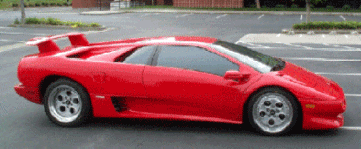 person to design
the new Lamborghini, but his initial design was altered, first under his
own directions, then under Chrysler. In the end he did put his
name on this outstanding car. In fact his signature can be seen on
a the right hand side of each Diablo in front of the rear wheel. The
Diablo was still a true Lamborghini, low, wide and extremely fast, its
top speed being about 210 MPH. The engine was a major upgrade on the
Countach V12. The displacement was now 5.7 liters (4
valves/cylinder) and a newly developed "multi-point" fuel injection
system was introduced. This electronic system has been developed by
Lamborghini. The engine itself could pump out as much as 492 bhp with
this new "LMI" system. In general the care was more refined than the
Countach. Gone were the big air intakes. They were now neatly
incorporated in the overall design. The air conditioner and
heating systems were better designed as was seat comfort. The doors now
had side windows in one piece, which go all the way down, and were
electrically powered.
person to design
the new Lamborghini, but his initial design was altered, first under his
own directions, then under Chrysler. In the end he did put his
name on this outstanding car. In fact his signature can be seen on
a the right hand side of each Diablo in front of the rear wheel. The
Diablo was still a true Lamborghini, low, wide and extremely fast, its
top speed being about 210 MPH. The engine was a major upgrade on the
Countach V12. The displacement was now 5.7 liters (4
valves/cylinder) and a newly developed "multi-point" fuel injection
system was introduced. This electronic system has been developed by
Lamborghini. The engine itself could pump out as much as 492 bhp with
this new "LMI" system. In general the care was more refined than the
Countach. Gone were the big air intakes. They were now neatly
incorporated in the overall design. The air conditioner and
heating systems were better designed as was seat comfort. The doors now
had side windows in one piece, which go all the way down, and were
electrically powered.
Side visibility was therefore much better than
on the Countach, also because at the front of the doors, the window-line
dipped down to allow a better viewing of the external mirrors. In
fact this dip of the front door is regarded by many as the most
beautiful region of the car -- sadly not reproduced in the most recent
Murciélago (see below). The total number of Lamborghini Diablo's built
over the years is probably 1000-1200 cars.
In 1993, after 3 years of the Diablo production, Lamborghini upgraded the Diablo to the Diablo VT. The VT stood for 'Viscous Traction'. VT is a mechanical linkage system constructed such that part of the engine power could be moved to the front wheels, should the rear wheels lost their grip -- a kind of four wheel drive system. Also an electronically adjustable Koni shock absorber system, with four settings chosen either manually or by the computer was added. Over 400 Diablo VT's were built. The engine (5.7L), delivered 492HP. Over 400 VT's were built.
In 1994 the Diablo SE30 was introduced to celebrate the 30th anniversary of Lamborghini. The engine was beefed up to about 520HP. It was a lighter car than its predecessors due to more carbon fiber being used. As the year went by further modifications of the SE30 were added. There was a "JOTA" edition that delivered up to 600HP due to camshaft and air intake modifications. These cars are really racing cars. Approximately 150 SE30's were built.
In 1995 the Diablo Roadster was introduced. A truly beautiful roadster. The design by Gandini was ingenious. The roof could be easily removed and reattached over the engine cover. About 200 roadsters were built.
In late 1995 Lamborghini also introduced the Diablo SV. This is really a lighter version of the standard VT. The whole front wheel drive system was removed and the engine was beefed up to 500HP. The car was significantly lighter and a little faster due to an altered gear-ratio. Less than 200 SV's were built.
The Diablo evolved over an almost 10 year period into its final form the 6.0L Diablo. The Diablo 6.0L was first shown in January 2000 at the Detroit Auto Show. It represents the final evolution stage of the Diablo line of cars. The entire car (with the exception of the roof and doors) was made of carbon fiber. The 6L V12 engine put out 550 bhp at 7100 RPM. The input valve variable timing first seen in the 1998 Diablo VT was improved to now include exhaust valve variable timing as well. The engine was also equipped with titanium connecting rods and a lighter crankshaft to improve performance.
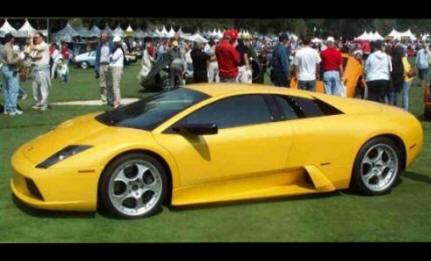 The
design featured very angular lines, especially at the front,
combined with magnificent curves with various air intakes
and outlets to cool the massive brakes and a fabulous
new V12 engine. Some complain of the air scoops for the rear
brakes which seem to be 'stuck on' rather than part of the
car. This may be corrected in later editions. All agree the
car is more impressive in real life than in photographs. The
new engine was designed with power output now up to 600 bhp.
One unique feature to the car is that when conditions
require it, the rear air intakes actually open up about 20
degrees to allow more air into the engine compartment, the
intake surface is increased by no less than 80 percent.
Most of the time the intakes will only be raised when the
car is at rest or driving slowly because at speed the
intakes are sufficient in their lowered position. The
positioning is fully automatic, although a dashboard mounted
button can also raise them. The intakes would automatically
open when the engine temperature rose above normal operating
levels or when the outside temperature was above 32C, also
once the speed of the car reaches 125 mph where air intake
is not a problem they close.
The
design featured very angular lines, especially at the front,
combined with magnificent curves with various air intakes
and outlets to cool the massive brakes and a fabulous
new V12 engine. Some complain of the air scoops for the rear
brakes which seem to be 'stuck on' rather than part of the
car. This may be corrected in later editions. All agree the
car is more impressive in real life than in photographs. The
new engine was designed with power output now up to 600 bhp.
One unique feature to the car is that when conditions
require it, the rear air intakes actually open up about 20
degrees to allow more air into the engine compartment, the
intake surface is increased by no less than 80 percent.
Most of the time the intakes will only be raised when the
car is at rest or driving slowly because at speed the
intakes are sufficient in their lowered position. The
positioning is fully automatic, although a dashboard mounted
button can also raise them. The intakes would automatically
open when the engine temperature rose above normal operating
levels or when the outside temperature was above 32C, also
once the speed of the car reaches 125 mph where air intake
is not a problem they close.
The engine in the Murciélago was still closely
related to the famous V12 t of the Countach and Diablo, but now used the
latest technology in motor design. A dry sump lubrication was used
on this 6.2 liter engine. This allowed the engine to be lowered a full 2
inches in the chassis, improving the weight ratio and
road holding
ability of the car. The gear box has been increased from 5 to 6 speeds.
A special system was installed to limit wheel spin when accelerating
fast, also the self blocking differentials (VT system) introduced
in the
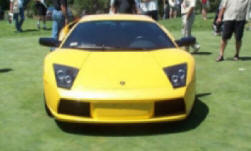 Diablo
were still used, 25% at the front axle, while 75% was used at the rear,
a further development of the ABS system also seen on the Diablo has been
integrated into the Murciélago. A new design 18 inch set of wheels was
incorporated into the design. These wheels used a special design
to maximize the cooling effect of the disc brakes. The tire size at the
front was slightly enlarged compared to the Diablo, while the rear
wheels were still covered with the massive 335/30 ZR 18 Pirelli's P Zero
'Rosso' tiers. As for the later Diablo's, the nose of the car can
be raised about 2 inches when driving over speed bumps or when driving
up a steep sloop. An adjustable rear wing spoiler also raises itself at
high speed. The spoiler is completely flush with the bodywork until the
car reaches about 65 MPH at which time it tilts up about 50 degrees.
Above 110 MPH it flips up further to 70 degrees. This gives the car
plenty of down-force for stable driving up to its maximum speed of about
210 MPH.
Diablo
were still used, 25% at the front axle, while 75% was used at the rear,
a further development of the ABS system also seen on the Diablo has been
integrated into the Murciélago. A new design 18 inch set of wheels was
incorporated into the design. These wheels used a special design
to maximize the cooling effect of the disc brakes. The tire size at the
front was slightly enlarged compared to the Diablo, while the rear
wheels were still covered with the massive 335/30 ZR 18 Pirelli's P Zero
'Rosso' tiers. As for the later Diablo's, the nose of the car can
be raised about 2 inches when driving over speed bumps or when driving
up a steep sloop. An adjustable rear wing spoiler also raises itself at
high speed. The spoiler is completely flush with the bodywork until the
car reaches about 65 MPH at which time it tilts up about 50 degrees.
Above 110 MPH it flips up further to 70 degrees. This gives the car
plenty of down-force for stable driving up to its maximum speed of about
210 MPH.
The interior of the Murciélago was also extensively redesigned. The dashboard no longer has the unique sloping curves of the later Diablo's. In fact it has a central panel more like the early Diablo's. Returned also is the passenger grab handle of the early Diablo's, but now it is on the left hand side by the gear shift as in the Miura's. There is much more headroom. The seats adjust better and the foot pedals are much better placed to be directly in front of the driver. The Alpine navigational system is still optional however. The doors still open upwards but now a little better.
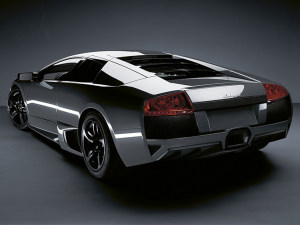 but
also the interior and exterior design. The Murciélago LP640 now
appears even more aggressive, with the new front and rear
bumpers contributing significantly to its appearance. The
exhaust system terminal has been incorporated in the diffuser on
the rear bumper. Other innovations include the rear lights,
which enhance the distinguishing features of the Murciélago
LP640, making it unmistakable even at night. The design of the
sides is also worth mentioning: while the area behind the air
intake on the right side is practically closed, the left side
features a vast aperture for cooling the oil radiator.
The engine of the new Murciélago LP640 has
undergone a radical modification. The increased bore and longer
stroke have boosted the displacement of the classic 60-degree
V-engine from 6.2 liters to 6.5 liters (6,496 cm). Thus the 580
hp engine power has now been elevated to an impressive peak of
640 hp at 8000 RPM. The 12-cylinder engine reaches a maximum
torque of 660 Nm at 6000 RPM.
but
also the interior and exterior design. The Murciélago LP640 now
appears even more aggressive, with the new front and rear
bumpers contributing significantly to its appearance. The
exhaust system terminal has been incorporated in the diffuser on
the rear bumper. Other innovations include the rear lights,
which enhance the distinguishing features of the Murciélago
LP640, making it unmistakable even at night. The design of the
sides is also worth mentioning: while the area behind the air
intake on the right side is practically closed, the left side
features a vast aperture for cooling the oil radiator.
The engine of the new Murciélago LP640 has
undergone a radical modification. The increased bore and longer
stroke have boosted the displacement of the classic 60-degree
V-engine from 6.2 liters to 6.5 liters (6,496 cm). Thus the 580
hp engine power has now been elevated to an impressive peak of
640 hp at 8000 RPM. The 12-cylinder engine reaches a maximum
torque of 660 Nm at 6000 RPM.For further details and specifications on the Murciélago click here.
The Gallardo
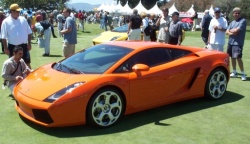 This
is the newest member of the Lamborghini family. It was first
shown at the Geneva International car show in March 6-10, 2003.
It is a smaller version of the Murciélago, keeping the signature
front view of that car. The engine is a 10 cylinder DOHC four
valve V10 (90 degree), 5 liter, 500 HP, torque 510 Nm (more
recent models are now up to 520 HP). The engine is
mounted under an optional transparent cover. The 90 degree angle
of the V12 allows for a lower overall car height. The car is
capable of reaching a top speed of about 185 MPH. List
price in the US was about $170,000 in 2003. Current prices start
around $210,000.
This
is the newest member of the Lamborghini family. It was first
shown at the Geneva International car show in March 6-10, 2003.
It is a smaller version of the Murciélago, keeping the signature
front view of that car. The engine is a 10 cylinder DOHC four
valve V10 (90 degree), 5 liter, 500 HP, torque 510 Nm (more
recent models are now up to 520 HP). The engine is
mounted under an optional transparent cover. The 90 degree angle
of the V12 allows for a lower overall car height. The car is
capable of reaching a top speed of about 185 MPH. List
price in the US was about $170,000 in 2003. Current prices start
around $210,000.The 'Gallardo' name (as for the Miura, Diablo and Murciélago) was taken from the world of bull fighting. Gallardo is the name or a breed of Spanish fighting bull first used in bullfighting in Spain in the 1800's. Historically, these bulls have enjoyed a well-deserved fame of being the most beautiful specimen within the race.
The styling of the Gallardo is quite refreshing, somewhat angular and odd shaped in some places, but quite unique to previous Lamborghini cars. The signature image of the car I think will be its forward leaning side view mirrors. These tend to create an impression of motion, when looking at the Gallardo from the side. The front of the Gallardo is similar to the Murciélago, with the same basic shape of the air intakes in a massive bumper/spoiler combination. There are large side air inlets that start on the doors and cut into the bodywork to allow fresh air into the engine. I think in fact that these are more integrated into the overall car than those of the Murciélago where they seem to stuck on as a kind of after thought. Disappointedly the doors on this Lamborghini open in the traditional way not upwards as for its close relatives. A real disappointment! As is currently the trend, wheel size has been enlarged to 19 inches all round.
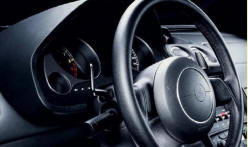 The
interior of the Gallardo is clean, very functional and finished in
the finest materials - mainly leather. An optional "paddle shifter"
or "E-gear" as Lamborghini calls it, eliminates the need for a
gearshift lever on the central console. This racing style F1 shifter
consists of two levers behind the steering wheel to control the
sequential gearbox. You can also get the car with a standard 6 speed
gearbox. The braking system, features a state of the art ABS/ESP
system along with a full "stability control system" (ESP) to
assist the driver in demanding conditions, while still allowing a
true sports driving experience. The actual brakes consist of 365mm
front and 335mm rear disks using Brembo 8-piston calipers in
the front and 4-piston calipers in the rear. The Gallardo,
Lamborghini claims exceeds all current European and North American
safety standards. Besides the normal driver's and passenger's 'dual
stage' front airbags, there are side 'head-thorax' side airbags and
door anti-intrusion bars.
The
interior of the Gallardo is clean, very functional and finished in
the finest materials - mainly leather. An optional "paddle shifter"
or "E-gear" as Lamborghini calls it, eliminates the need for a
gearshift lever on the central console. This racing style F1 shifter
consists of two levers behind the steering wheel to control the
sequential gearbox. You can also get the car with a standard 6 speed
gearbox. The braking system, features a state of the art ABS/ESP
system along with a full "stability control system" (ESP) to
assist the driver in demanding conditions, while still allowing a
true sports driving experience. The actual brakes consist of 365mm
front and 335mm rear disks using Brembo 8-piston calipers in
the front and 4-piston calipers in the rear. The Gallardo,
Lamborghini claims exceeds all current European and North American
safety standards. Besides the normal driver's and passenger's 'dual
stage' front airbags, there are side 'head-thorax' side airbags and
door anti-intrusion bars.
Gallardo SE
In September 2005 Lamborghini introduced the
Gallardo SE at the IAA car show in Frankfurt. A
total production of only 250 units was
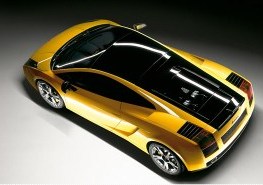 planned.
The car has a high gloss black (Nero Octis) roof which contrast heavily with
both the yellow or white bodywork. The Gallardo SE has a two-tone interior, all
piping and stitching on the premium quality leather is executed in the same
color as the bodywork of the car. Also the black floor mats have color
coded borders. There are Lamborghini shields on the headrests and the script on
the dashboard. There is a rear view camera system integrated into the back
spoiler. There is an upgraded multimedia system as well. However the navigation system
is still optional. A sport suspension and an exclusive engine cover also come
with the car. The e-Gear, which features a 'thrust' mode to offer even
more impressive acceleration by improving the gear change through the different
gears. With the modified engine now delivering 520 Bhp at 8000 RPM, it only
takes 4 seconds flat to reach 60MPH and the top speed of ~190 MPH.
planned.
The car has a high gloss black (Nero Octis) roof which contrast heavily with
both the yellow or white bodywork. The Gallardo SE has a two-tone interior, all
piping and stitching on the premium quality leather is executed in the same
color as the bodywork of the car. Also the black floor mats have color
coded borders. There are Lamborghini shields on the headrests and the script on
the dashboard. There is a rear view camera system integrated into the back
spoiler. There is an upgraded multimedia system as well. However the navigation system
is still optional. A sport suspension and an exclusive engine cover also come
with the car. The e-Gear, which features a 'thrust' mode to offer even
more impressive acceleration by improving the gear change through the different
gears. With the modified engine now delivering 520 Bhp at 8000 RPM, it only
takes 4 seconds flat to reach 60MPH and the top speed of ~190 MPH.
Gallardo Superlegger
In March of 2007 Lamborghini introduced the
Gallardo Superlegger at the Geneva Auto show.
Lamborghini removed about 200 lbs of weight from
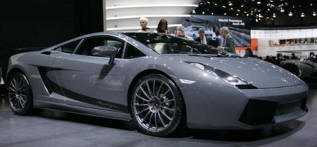 the
standard Gallardo. By tweaking the engine timing and modifying the muffler and
air intakes the horsepower has been raised to 530HP.
To achieve such a weight loss a lot
of parts on the standard Gallardo have been replaced. These include the inner
door panels - which are now finished in clear Carbon Fiber. The seats are no
longer electrically adjustable. The engine cover on the Superleggera has been
replaced by a clear Carbon Fiber unit featuring a light weight Polycarbonate
transparent section. Even the windscreen has been made thinner to further reduce
weight. The exterior rear view mirrors are also finished in Carbon Fiber and the
rear bumper now also features a clear Carbon Fiber lower section as are the
lower side sills.
the
standard Gallardo. By tweaking the engine timing and modifying the muffler and
air intakes the horsepower has been raised to 530HP.
To achieve such a weight loss a lot
of parts on the standard Gallardo have been replaced. These include the inner
door panels - which are now finished in clear Carbon Fiber. The seats are no
longer electrically adjustable. The engine cover on the Superleggera has been
replaced by a clear Carbon Fiber unit featuring a light weight Polycarbonate
transparent section. Even the windscreen has been made thinner to further reduce
weight. The exterior rear view mirrors are also finished in Carbon Fiber and the
rear bumper now also features a clear Carbon Fiber lower section as are the
lower side sills.
For further
details and specifications on the Gallardo click
here.
Contact Information
In hopes to keep this wonderful site running and keep John Monahan's work around for everyone to benefit from, Lamboweb.com was transfered to Jason Jones (owner of Bullstuff.com) in 2014 to continue to maintain and update while John has "retired" from the website.
If you have a technical question please use our forum.
|
|
|